
Robert Filliou
One Hundred Years, Three Months and Three Days
Prats Nogueras Blanchard, MadridNov 26 - Jan 30, 2027
Opening: Thursday 3 Dec. 6 – 8 pm
Prats Nogueras Blanchard is pleased to present Cien años, tres meses y tres días (One Hundred Years, Three Months and Three Days), an exhibition of Robert Filliou (Sauve, 1926 – Les Eyzies, 1987) in our Madrid space, following the two shows NoguerasBlanchard devoted to the artist in 2019 and 2021.
If pursued cannot be captured—it vanishes and vanishes elusive as mist
- Shabkar Tsogdruk Rangdrol, Flight of the Garuda (19th century)[1]
The Dordogne, in south-western France, is one of the great centres of prehistoric art. Hidden in the limestone valleys around Les Eyzies are caves and rock shelters that hold some of humanity's earliest images, painted and engraved thousands of years ago with natural pigments by the flickering light of lamps. The critic Lucy R. Lippard, who devoted her book Overlay (1983) to the affinities between contemporary art and Prehistoric art, described such ancient sites and images as 'talismans, aids to memory, outlets for the imagination that can't be regulated, owned, or manipulated like so much contemporary art'.[2] In this dialogue between the most ancient and the most recent, Lippard identified a tension running through modern life and art: the one 'between the ephemeral and the permanent—or life and death'.[3]
It was there, in the Dordogne, that Robert Filliou (Sauve, 1926 – Les Eyzies, 1987) settled in 1979, near a centre for Tibetan studies, and there that he died during a Buddhist retreat at Chanteloube that was meant to last three years, three months and three days. One Hundred Years, Three Months and Three Days, the exhibition with which Prats Nogueras Blanchard marks the centenary of his birth, brings together in its title these two measures of time: the century since he was born and the retreat that was left unfinished.
A key figure of Fluxus, Filliou understood art as a game of research that could take place in any medium, or not take place at all and remain an unrealised idea. Outside the conventions of the market, his 'artistic propositions' spanned action poetry, happenings, poem-objects, mail art, books, games, multiples, film and video. He conceived them not as objects of cultural consumption but as tools for understanding and for change, applied to social and political life. His 'poetic economy' rests on three systems: Permanent Creation, the Eternal Network and the Principle of Equivalence, according to which it makes no difference whether a work is well made, badly made or not made. With them he dismantled the hierarchy of individual genius and of art as a commodity, and made the viewer a co-creator.
Filliou even gave art a birthday: Art's Birthday, a celebration held every 17 January, the very day he was born. Zen Buddhism, which he discovered in Japan and South Korea in the early 1950s while working for the United Nations on the reconstruction of South Korea, pervades his work with the idea of impermanence and an understanding of reality as at once empty and full. Filliou distilled it into his 'Absolute Secret of Permanent Creation': 'Desire nothing, decide nothing, choose nothing, be aware of yourself, stay awake, calmly seated, do nothing.' Cut short by his death, that retreat can be read as his last great work: a work not made, true to his Principle of Equivalence.
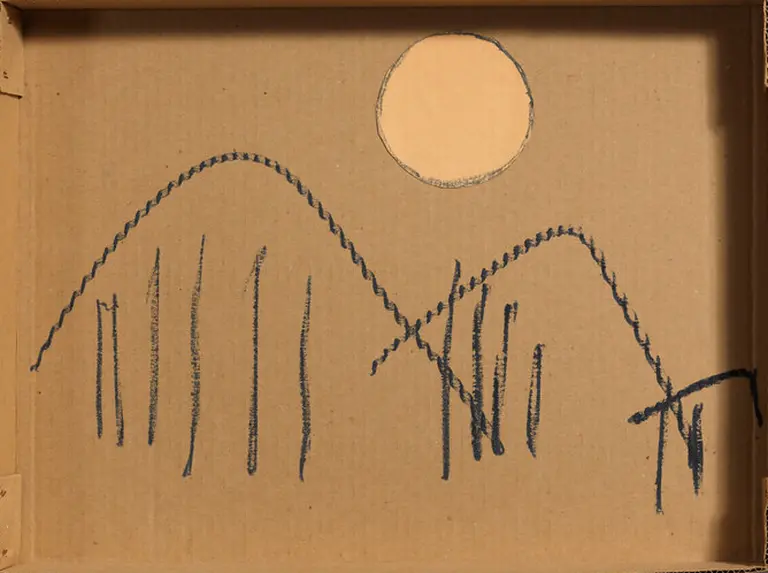
The exhibition brings together multiples, editions and unique pieces made between 1965 and 1984 from humble, everyday materials: wooden boxes with printed labels, a stone, nails, index cards, a matchbox, kraft paper and graph paper, alongside screenprints, lithographs and offset prints. Cardboard is the material he returns to most often: boxes folded, cut, nailed or drawn on in pencil, pastel and ink, a poor and fragile support that embodies the idea of an art within everyone's reach. In A Joint Work of Robert Filliou and Time (It took me 2 months to finish this piece) (1971), a piece of cardboard folded and nailed to a wooden panel, time appears as the work's co-author. Research in Art and Astrology (1972) runs through the signs of the zodiac in twelve screenprints on card: over photographs of streets and interiors, Filliou notes the dates of each sign and the names of figures born under it – Beethoven, Rilke and Heisenberg for Sagittarius; Nietzsche, Heidegger and Kleist for Libra – turning the year into a cycle that begins again. La Cédille qui sourit (1969), a matchbox with cut-out cards and a hook made with George Brecht, takes its name from the shop-cum-workshop the two ran in Villefranche-sur-Mer from 1965 to 1968, an 'International Centre of Permanent Creation' that was almost always closed to the public. Together, these works portray an artist for whom art was not an object to be finished but a process that continues, even beyond one's own life.
[1] Shabkar Tsogdruk Rangdrol, Flight of the Garuda, translated by Tony Duff, Kathmandu, Padma Karpo Translation Committee, 2011. Spanish translation based on the English version.
[2] Lucy R. Lippard, Overlay: Contemporary Art and the Art of Prehistory, Nueva York, Pantheon Books, 1983, p. 8. Las traducciones al castellano de las citas son propias.
[3] Ibid., p. 122.
Cristina Ramos